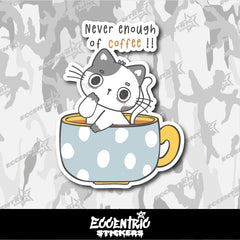
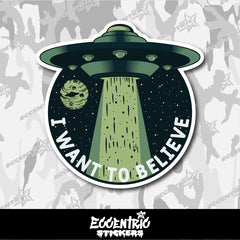
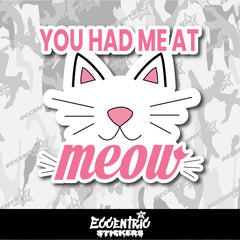
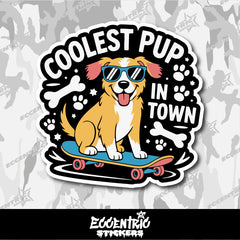
Every sticker we print starts as the same thing: your art, on premium vinyl, under a laminate that shrugs off rain. The word that changes the price, the packaging and the peel is the cut. Here's the whole thing, with pictures, in the time it takes to finish a coffee.
Die-cut: the sticker is the shape
The blade goes through the vinyl and the backing paper, so what comes out of the press is a sticker shaped exactly like your art — a cat, a logo, a lightning bolt — with nothing around it. Peel, stick, done.
It's the format people picture when they say "sticker". It's also the one that gets handed out by the fistful: bag seals, box seals, the freebie in every order, the one that ends up on somebody's water bottle at the gym. If the sticker is going straight onto a surface and should look like the art rather than a label, this is it.
Kiss-cut: one sticker, on its own card
Same blade, lighter touch. It cuts through the vinyl and laminate and then stops — the backing underneath stays a whole rectangle. You get a sticker cut to its outline, sitting on a small card.
That card is the whole point. It's the thing that drops into a mailer without curling, sits on a reception desk, goes in a thank-you note, and gives you somewhere to print a message or a handle. It also makes fiddly shapes easier to peel, because you've got a corner of backing to start from instead of your fingernail.
Sheet: a whole kit on one page
Now do that kiss-cut trick several times on one page-sized backing. A logo, a QR code, three product labels, a couple of asset tags — one order, one sheet, every piece peels away on its own.
Sheets are for anything that's handed over as a set: a new-hire welcome pack, a sales kit, a retail insert, an Artist Alley collection. They're also the cheapest way to get many different designs printed without placing many different orders.
The one question that settles it
Where is the sticker the moment before it's stuck?
- In someone's hand, about to go on a surface → die-cut.
- In an envelope, a box, or on a desk, waiting → kiss-cut.
- In a pack with its siblings → sheet.
That's genuinely it. Everything else — price, size, holographic or matte — is decided on the product page after you've answered that.
Does the cut change the price?
A little, and in the direction you'd guess: a die-cut single is priced per sticker, a sheet is priced per sheet and carries several designs, and kiss-cut sits in between because of the card. Every product page shows the whole run table with the per-piece price, so you can compare a sheet of six designs against six die-cut runs in about four seconds. Volume pricing applies at every tier on all three.
What about QR code stickers?
A QR sticker is a die-cut with a scannable code placed beside your artwork — same format, one extra job. If you want a tap instead of a typed link on a table, a counter, a cup or a box, that's its own page →
Still torn? Order a short run of one and a short run of the other. The smallest runs cost less than lunch, and both ship in 1–2 business days.
Compare all formats